I am going to Palestine for three months out of a sense of humanity and in solidarity with the Palestinians who, day in and day out, must endure apartheid, threats, and the inhumane Zionist violence perpetrated by the State of Israel and violent settlers.
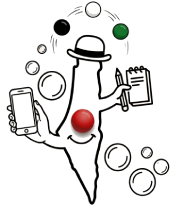
I’m going there to do solidarity work by being present as an outsider, in the hope that this will have a deterrent effect on the perpetrators of violence. In addition, I’ll try to document the events I witness as thoroughly as possible and report on them. On top of that, I want to meet local residents—especially children—in a playful way and share some of my passions with them, such as juggling, clowning, giant soap bubbles, and kites.
On Sunday, October 4, I’m flying to Amman, the capital of Jordan, from where I’ll head to the Israeli border the next day, hoping to be allowed in and to get a three-month visa. From there, I’ll cross the West Bank on my way to Jerusalem to buy a local phone number before heading to Ramallah, where I’ll take a two-day training course. This is in addition to the twelve-hour training I’ve already completed online with the International Solidarity Movement (ISM), the organization through which I’ll be volunteering in the West Bank. This Palestinian-led organization will send us out in pairs to villages and farms in rural areas where violence is expected. We’ll stay with the local residents for a short time to support and assist them.
Ever since I was young, I have been outraged by what is happening in Israel and Palestine. The developments of recent years, both in the West Bank and in Gaza, tear my heart apart, bringing me to tears, especially when it comes to the plight of the children. It all feels like a great injustice—an injustice in which our Western and Belgian governments, as well as a large number of companies and universities, are complicit.
After several years of reduced or more indirect involvement, I feel the need to reengage more deeply with activism. I want to throw my body and my privileges into the struggle. Not only the Palestinian cause, but also other issues are close to my heart. However, what’s happening in Palestine today strongly reminds me, on an ideological level, of what the Nazis did in the 1930s and 1940s. I wouldn’t be able to look at myself in the mirror later on if I hadn’t tried to do something beyond just protesting here.
At the same time, I’m aware that, in my personal life, I have a strained relationship with conflict. Sometimes I exhibit conflict-avoidant behavior, while at other times I react too strongly to conflicts emotionally. I therefore wonder if this is partly the reason behind my decision to go to a conflict zone. Perhaps it’s also a way to challenge myself and better understand my relationship with conflict.
Over the past few years, I’ve learned various techniques and tools to take better care of myself emotionally. These include breathing techniques, voice work, self-massage, and forms of therapeutic expression, such as clowning, neurographic drawing, and singing. These techniques will certainly come in handy to support myself during this work and to deal in a healthy way with whatever I experience on site.
Apartheid, the concentration camps—including Gaza, the cities in the West Bank, and the prisons where torture and other human rights violations take place—and the racist legislation and government, with its practices of colonialism and ethnic cleansing, are unacceptable to me. I may not be able to change what is unacceptable on my own, but I can try to make a difference in the unacceptable conditions in which some Palestinians live. I refuse to simply accept what I find unacceptable.
I hope to be able to do this work for a little over a month, possibly followed by or interspersed with other, “lighter” work. I am well aware of the psychological and emotional risks this work entails. I’m a sensitive person, and I’m also worried about how all of this will affect me. That’s why I’ve already been in touch with other local organizations, such as the Palestinian circus school and Red Noses, an organization of hospital clowns.
The clown plays an important role in my life. Etymologically, the word “paljas” is linked to “clown,” just like the Spanish word for it: “payaso.” That’s where the name of my project, Paljastina, comes from. You can find it on social media—on Facebook and Instagram—and it has its own website: Paljastina.be.